Lifecycle marketing · Multi-market operations
Marketing Automation Engine
A shared campaign operating system turns one structured brief into channel-ready work while marketers retain control of audience, localisation, and every live send.
- Project context
- Internal project built in an in-house role at FunNow Group.
- My role
- Strategy, process design, automation architecture, and delivery
- Scope
- Two brands and multiple APAC markets; push, email, in-app, video, and blog workflows.
- Operating outcome
- Less repetitive setup, more consistent execution, and one reviewable path from brief to dispatch.
The operating problem
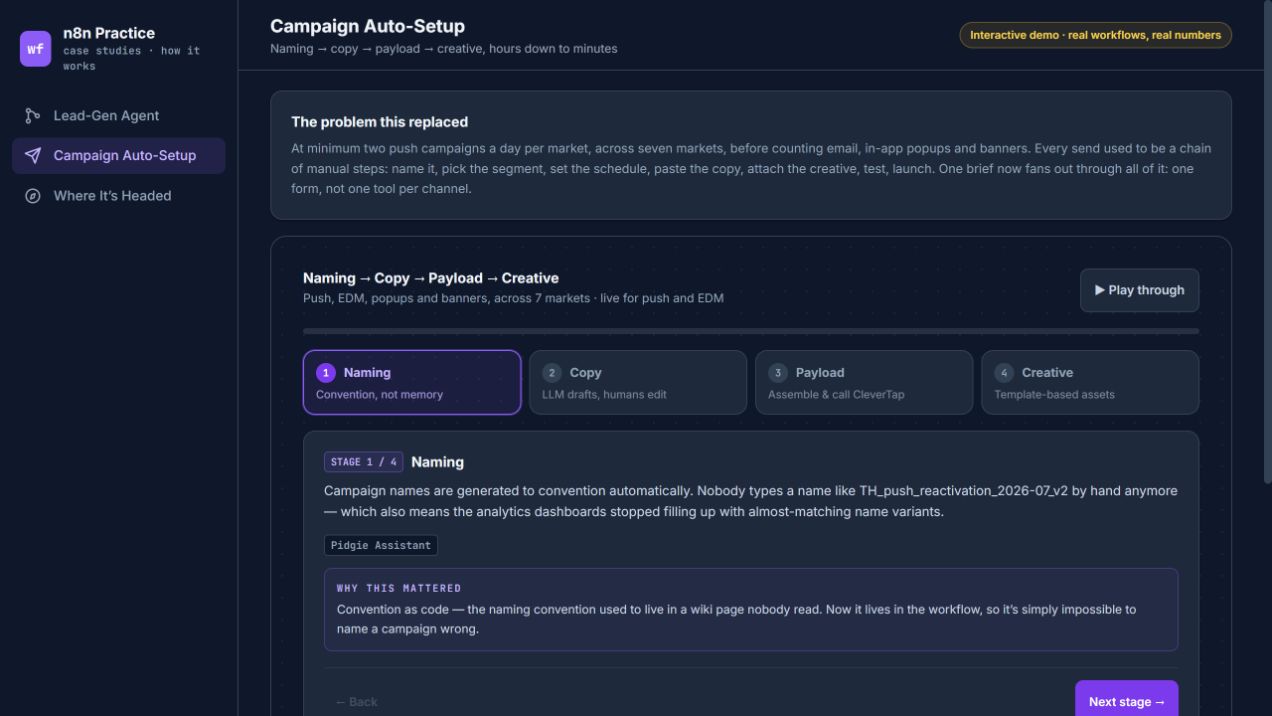
Campaign production had become a chain of manual decisions: naming, segment selection, local scheduling, copy preparation, creative assembly, testing, and launch. Repeating that chain across brands, markets, and channels made consistency difficult and left skilled marketers spending time on setup rather than campaign judgement.
The design question was not simply how to generate copy faster. It was how to create one dependable operating path without hiding market context or handing publishing authority to a model.
The decisions behind the system
I designed the brief as the shared source for each campaign. Market, objective, audience, schedule window, and content angle enter once; the workflow prepares the channel-specific pieces. Naming conventions live in the automation, so reporting receives predictable identifiers instead of near-matching manual variants.
n8n coordinates the flow, language models prepare first drafts and localisation, template services produce routine creative, an internal admin layer routes work, and CleverTap creates or delivers the campaign. Each integration has a defined responsibility rather than one opaque automation doing everything.
- One structured brief can feed push, email, in-app, video, and blog preparation.
- Audience rules can use lifecycle signals such as CLTV, churn risk, and dormancy.
- API requests are logged so operators can inspect what the workflow sent.
Human review is part of the workflow
AI produces a starting draft; it does not own the message. Marketers review copy, localisation, audience, creative, and schedule before a live send. This preserves local judgement and gives the team a clear place to catch an unsuitable translation, an incorrect segment, or a campaign that should not run.
Logs, status signals, and explicit checkpoints also expose exceptions. Operators can see what completed, what needs attention, and what data the workflow actually sent.
Operating outcome
Campaign setup moved from a repeated manual chain to one structured, reviewable flow. Naming is generated consistently, one brief feeds multiple preparation steps, every live send retains human approval, and operators have a record to inspect when an output looks wrong.
The result is a system that spends automation on repeatable preparation while preserving marketer attention for audience choice, message quality, and whether a campaign should run at all.
Handover and evolution
A production workflow needs owners, operating notes, failure guidance, and enough context for another person to change it. The system is documented around inputs, approvals, integration boundaries, and common exceptions rather than around a single builder’s memory.
One rollout lesson was to stabilise one channel before adding the next. That reduces the number of integrations being debugged at once and gets useful work into operators’ hands sooner.
What I would carry into the next build
- Automate the setup chain while keeping campaign judgement with marketers.
- Encode conventions and logging so reporting and diagnosis stay reliable.
- Design approvals, exceptions, and handover alongside the happy path.
Does your team have a similar problem?
Send the current steps, the tools involved, and where work gets held up.